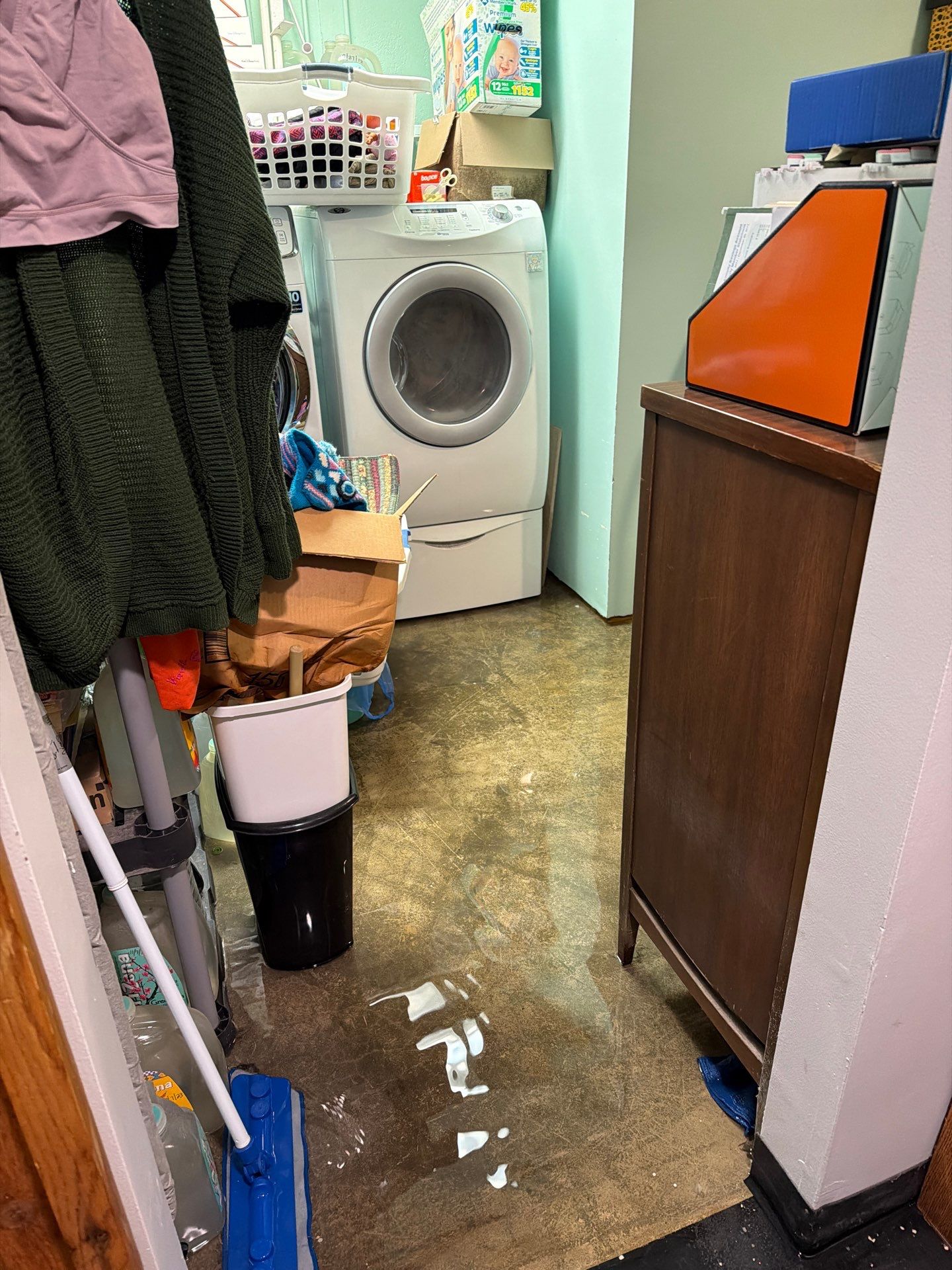
The Broken Supply Line on College Avenue
Back to that 6:47 a.m. call. When our technician arrived, he metered the carpet with a penetrating moisture probe and found readings above 35% across roughly 240 square feet. The pad was saturated. Because the source was a clean copper supply line and the water had been sitting under twelve hours, we classified it as Category 1 under IICRC guidelines. That category matters because it determined whether we could dry the carpet in place or had to pull and dispose of the pad.
We extracted standing moisture with a weighted extraction wand, made two passes across every square foot, pulled the pad in the worst section near the laundry closet, and set six air movers and a low grain refrigerant dehumidifier. Total invoice came to roughly $1,940. Insurance covered everything past her $1,000 deductible because we documented daily moisture readings and submitted them with our Xactimate scope. She kept the carpet. The pad we replaced cost her $310 of that total.
What the homeowner did not see on the invoice was the four return visits over the following week. Day two readings dropped to 22%. Day three we repositioned two air movers toward the tack strip along the exterior wall, which was holding moisture longer because of the temperature differential. Day four we pulled equipment from the dining room half and kept two units running near the laundry closet. Day five the carpet metered within two points of an unaffected bedroom. That documentation trail is what made her claim painless.
The Finished Basement in Avalon Place
A few months later a Avalon family came home from a weekend at the lake to find their finished basement carpet wet across nearly the entire 900 square feet. A failed sump pump float was the culprit. Water had been pooling for an estimated 36 hours. This one was different. The water had touched a floor drain, which under S500 pushes the classification to Category 2 grey water at minimum. The pad had to go. The carpet itself was borderline.
We discussed the math with the homeowner directly. Replacing 900 square feet of mid-grade carpet and pad would run roughly $4,200 installed. Professional cleaning, antimicrobial treatment, in-place drying with eight air movers and two commercial dehus for four days, plus pad replacement, came in at $3,150. They chose to save the carpet. We monitored moisture daily, and on day four the readings on the subfloor and tack strip matched the dry standard from an unaffected area of the home. If you want the deeper breakdown on basement scenarios, our guide on flooded basement cleanup and professional drying walks through more of these decisions.
What an Honest Estimate Looks Like
One Avalon homeowner showed us three competing estimates last fall. One was a flat $850 with no scope detail. One was $6,400 and included replacement of carpet that was clearly salvageable. Ours was $2,260 with moisture readings, equipment counts, daily monitoring notes, and a clear line about what we would do if hidden subfloor damage turned up. He chose us, and the final invoice matched the estimate within $40. That is what you should expect from any IICRC certified firm. Numbers tied to readings, scope tied to the S500 standard, and a phone number that gets answered when something changes mid-job.
The First 24 Hours Decide Almost Everything
A homeowner in Avalon called us at 11:14 p.m. on a Tuesday after a dishwasher hose let go during the rinse cycle. Water had reached the carpeted dining room. She did the right things. She shut off the supply valve, pulled chairs off the carpet, threw towels at the worst of it, and called. We had a truck on site within 90 minutes. Because we extracted while the water was still fresh and Category 1, the entire job ran $1,420 and finished in three days. The same scenario discovered Friday morning after sitting since Tuesday night would have run closer to $3,800 with pad replacement and antimicrobial work. Speed is the single biggest cost lever you control. Our team operates a 24 hour water damage restoration response across central Indiana for exactly this reason.
The Townhome Where We Said No
Not every call ends with us writing a scope. A Avalon townhome owner called about a slow toilet supply leak that had wet about 60 square feet of bedroom carpet. By the time he reached us, the carpet had been damp for five days. He had run a box fan on it. The smell told the story before our meter did. We pulled a corner, found visible mold growth on the backing and pad, and walked him through the bad news. At that point you are not drying anymore. You are remediating. We referred him to our mold protocol and the mold after water damage removal and prevention playbook. If we cannot help you with the original problem, we will tell you directly. That call cost him nothing.
What Drives the Number on Your Invoice
Across hundreds of Avalon carpet jobs, a few factors swing the cost more than anything else:
- Water category. Category 1 clean water dries in place. Category 2 usually means pad replacement. Category 3 (sewage, flood water) means the carpet is gone.
- Square footage and access. A 200 square foot bedroom with one doorway dries faster and cheaper than 800 square feet of open basement with furniture to move.
- Dwell time. Under 24 hours, your odds are good. Past 48 hours, expect rising costs and harder calls about what stays.
- Subfloor type. Concrete slabs hold and release moisture differently than plywood. Plywood subfloors that stayed wet too long sometimes need replacement, which is a separate line item entirely.
- Dehumidifier days. Each commercial dehu runs roughly $75 to $110 per day on a typical residential job, and most carpet dries in three to five days.
Why DIY Drying Usually Backfires
We get the call about twice a month from a Avalon homeowner who ran fans for a week and thought the carpet was dry. The surface fibers feel fine. The pad underneath is still at 28%. By then the tack strip has rusted, the subfloor is staining, and the room has that musty note that does not come out with a rental cleaner. A consumer box fan moves maybe 1,800 CFM with no real dehumidification behind it. Our axial movers push closer to 3,000 CFM each, paired with a dehu pulling 90 pints a day out of the air. That difference is what gets pad and substrate dry before microbial growth starts at the 48 to 72 hour mark. Avalon Water Restoration crews see the failed DIY jobs often enough that we built a flat-rate assessment visit so homeowners can find out where they really stand before committing to a full scope.